Jump to content


Photo

[Old Johnson Street Bridge] Photos and historical discussion


  • Please log in to reply
165 replies to this topic

#1 aastra

aastra
  • Member
  • 22,961 posts

Posted 06 April 2009 - 10:59 PM

Vic West was certainly a different animal in those days. In terms of roads and streets it seems to have been stuck in the stone age even in the 1960s.


Was there another little rail overpass over Harbour Road?


Yep.


#2 aastra

aastra
  • Member
  • 22,961 posts

Posted 06 April 2009 - 11:20 PM

That last picture should make it obvious as to why they decided to curve the road under and around.

Also, we should keep in mind the situation on the downtown side at that time. Short of a major reconfiguration, the car route had to be on the south side because the north side (where the trains were) went nowhere. When cars became king, it made sense to finally undertake the gutting and rejigging of that whole area, including the elimination of city blocks and not insignificant buildings.


#3 aastra

aastra
  • Member
  • 22,961 posts

Posted 06 April 2009 - 11:58 PM

...building the car bridge north of the train bridge wouldn't have necessitated either of those things.


You're right, and I think we all agree that putting the cars on the north side would make for the simplest configuration. But I'm making the point that back then it was no small deal to put the cars on the north side. You had the city to contend with on the east side and the rail lines to contend with on the west side. A lot has happened over the decades to make (for example) UrbanRail's vision much more feasible than it ever would have seemed before.

#4 amor de cosmos

amor de cosmos

    BUILD

  • Member
  • 7,387 posts

Posted 07 April 2009 - 05:44 AM

th E&N tracks didn't stop at the janion building, they kept going to a yard in front of capital iron where there is a big parking lot now. that would have created problems if they wanted to put the tracks on the south side.

#5 UrbanRail

UrbanRail
  • Member
  • 2,114 posts
  • LocationVictoria

Posted 07 April 2009 - 04:31 PM

I don't know what the story is behind the existing alignment but I think we can safely assume that the curve doesn't exist because some stupid bureaucrat ~100 years ago arbitrarily decided that it should exist.


Since automobiles came along well after the railway, I have to think that the curved road and the short rail overpass were introduced simply to keep the two modes safely apart. You know, so people could go fast without the bother of needing to pay attention.

The original bridge was a rail bridge only, yes? So then along came these new-fangled horseless carriages and the need for a new bridge. Call me a wingnut but it appears that some genius had the bright idea of 1) leaving the tracks where they were, while 2) tunnelling the new-and-improved automobile route beneath the tracks at a suitably high point, and then 3) bringing the automobile route around to run alongside the tracks, so that both modes could share the same bridge, but without ever actually crossing over one another.

Pretty good idea.


Yes you are correct the original swing bridge was rail only.

From the BC Archives. Date March 1888


#6 UrbanRail

UrbanRail
  • Member
  • 2,114 posts
  • LocationVictoria

Posted 07 April 2009 - 04:43 PM

I believe the reason the current bridge was built in its configuration was because Johnson St was a thru road, pandora did not exist beyond Government, Cormorant St did go across Douglas from Blanshard to Store St and ended at the front of the station. The station already existed at this point so engineers put the road under the tracks to align Esqumalt Rd with Johnson St. The new bridge was built beside the old bridge. At the time of the design of the bridge, I believe it was to be bigger to allow streetcar service on the same bridge, but the BCER dropped out of the planning at the last minute, I think because of financial reasons. In 1972, the station was removed and Pandora and Johnson St were made into one way streets, completed in I believe 1974. Anyway something to that effect.

Also if you noticed in old aerial photos, there were buildings along Johnson near Store St as well as the rail station, tearing buildings down at that time was not an option.

I believe only two bridges were ever built on this site, the old swing bridge and current bridge.

#7 aastra

aastra
  • Member
  • 22,961 posts

Posted 07 April 2009 - 04:55 PM

It seems as if a lot of fill was added on the Vic West side at some point.


Here's the original bridge. Notice that there was no accommodation for either cars or trains. Silly bureaucrats.


#8 UrbanRail

UrbanRail
  • Member
  • 2,114 posts
  • LocationVictoria

Posted 07 April 2009 - 05:11 PM

It seems as if a lot of fill was added on the Vic West side at some point.


Here's the original bridge. Notice that there was no accommodation for either cars or trains. Silly bureaucrats.


You are right, a lot of fill was added on the Vic West side.

#9 UrbanRail

UrbanRail
  • Member
  • 2,114 posts
  • LocationVictoria

Posted 07 April 2009 - 05:17 PM

Again from the BC Archives. A drawing of the construction of the Blue Bridge.

Date May 10, 1922


Interestingly to note, it looks like they built the bridge in the upright position.

Edit

Ahh, I think I know why, since the counterweights were concrete, they would have had to form them closer to the ground, and then when they set, and the bridge was completed, it was simply lowered.

#10 gumgum

gumgum
  • Member
  • 7,069 posts

Posted 07 April 2009 - 06:29 PM

Awesome^.

#11 yodsaker

yodsaker
  • Member
  • 1,280 posts

Posted 07 April 2009 - 08:56 PM

Nice work guys!

#12 pseudotsuga

pseudotsuga
  • Member
  • 287 posts

Posted 07 April 2009 - 09:39 PM

Very interesting!
Poster potential for somewhere on the bridge, whatever happens to it.

#13 aastra

aastra
  • Member
  • 22,961 posts

Posted 08 April 2009 - 08:41 AM

No. What i'm asking is this; why didn't Esquimalt Rd simply keep going down the hill (travelling east) and the city build the parallel vehicle bridge on the other side of the train bridge than the way it is now so that it would have joined up with the bottom of Pandora St. (before Pandora was one-way) on the other side? That seems infinitely easier than what they designed 89 years ago which was to build a tunnel/overpass/sharp turn and then double back up the south side of the train bridge. I have no idea why you mentioned 100, 80 and 45 years ago because the bridge was built 85 years ago.


Sigh. You do realize that Pandora wasn't Pandora back then, right?


Your questions have already been answered. I'll simplify it to this:

What you're actually asking is this: Why didn't they optimize the road & rail situation ~100 years ago or ~80 years ago, instead of putting it off until ~45 years ago (and even then only going partway)?


Why didn't they anticipate the automobile age/death of streetcars and gut north downtown in order to create long continuous thoroughfares connecting Esquimalt and Oak Bay through downtown Victoria...back in the 1920s?

Because they were stupid. They liked complicated solutions that they knew would piss people off.

#14 UrbanRail

UrbanRail
  • Member
  • 2,114 posts
  • LocationVictoria

Posted 08 April 2009 - 07:25 PM

Wouldn't it have been simpler if the folks in the 1920s had contacted a psychic and looked into the future to see what the best configuration would be to satisfy Victoria's requirements in the 21st century?


I think at the time that was the best configuration, as the E&N was still the main way to transport freight and passengers between Victoria and points north. Plus car traffic was pretty much nil back then. I would imagine the engineers and city planners probably didn't things would change that much.

#15 Holden West

Holden West

    Va va voom!

  • Member
  • 9,058 posts

Posted 08 April 2009 - 08:13 PM

Read this quote from Gordon Price in the Saskatoon StarPhoenix:

Until the 1920s and 1930s, city streets were the domain of pedestrians, trolley buses, horse-drawn wagons, bicycles and kids at play. Cars and trucks were an emerging form of transportation, just one component of street traffic.

“In the 1920s,” says urban planner Gordon Price, “it was still unclear whether the public would accept private vehicles. There was a lot of carnage from traffic accidents and civic leaders were dubious about the large amount of space cars needed. Many thought curb parking should not be allowed.”


"Beaver, ahoy!""The bridge is like a magnet, attracting both pedestrians and over 30,000 vehicles daily who enjoy the views of Victoria's harbour. The skyline may change, but "Big Blue" as some call it, will always be there."
-City of Victoria website, 2009

#16 UrbanRail

UrbanRail
  • Member
  • 2,114 posts
  • LocationVictoria

Posted 19 April 2009 - 08:44 AM

As much as I love the old bridge, I am leaning towards replacing it. We have an opportunity to design and construct a brand new bridge that can be just as iconic as the old one, but one that embraces alternative forms of transport; cycling, walking, transit, rail and not just the car.

City Council is asking for your input on what to do. Here is the link to sending your thoughts by April 23.

http://www.victoria....st-bridge.shtml

Here are some more historic pictures of its construction.


#17 UrbanRail

UrbanRail
  • Member
  • 2,114 posts
  • LocationVictoria

Posted 19 April 2009 - 10:01 AM

Not sure if anyone can see, but in the second picture there are streetcar tracks being placed in the middle of the road span section. The BCER never used the bridge, and the tracks were removed some time later.

#18 D.L.

D.L.
  • Member
  • 7,786 posts

Posted 14 July 2009 - 07:26 AM


Source unknown


Source unknown

#19 aastra

aastra
  • Member
  • 22,961 posts

Posted 11 August 2009 - 04:20 PM

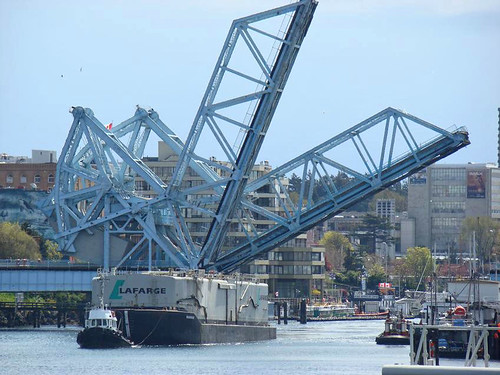
It seems as if there's still some confusion about the two bascule bridges in San Francisco. The Third Street ("Lefty O'Doul") Bridge closely resembles the Johnson Street Bridge in Victoria, but is a few years younger than Victoria's bridge. The Fourth Street Bridge is a few years older than the Johnson Street Bridge, but it's a different design and does not resemble Victoria's bridge or the Third Street Bridge. It was the Fourth Street Bridge that underwent the controversial rehab to which Victorians often make reference. The Third Street Bridge was also repaired recently and the comparison to that bridge would seem to be much more relevant, but details seem to be lacking.

The confusion is perpetuated on this page:
http://johnsonstreetbridge.org/?p=117

Interesting tidbit: The link below indicates that the Third Street Bridge was once the third largest bridge of its type in the world.
http://www.waymarkin.../waymarks/WMJD5

Is this true? I have no idea. But if it is true then I have to wonder how the Johnson Street Bridge ranked?

There's an older, similar-looking bascule bridge in Thunder Bay, Ontario that seems to be larger than the bridges in Victoria or San Francisco. If these three bridges are indeed of the same "type", then was Thunder Bay's Jackknife bridge the largest in the world for a time? The St. Charles Air Line Bridge in Chicago was apparently the longest bascule bridge for some years before it was shortened. It's a few years older than Victoria's bridge. Were the St. Charles Air Line Bridge and Thunder Bay's Jackknife Bridge number one and number two? If so, which bridge was number three before San Francisco's Third Street Bridge came along? Victoria's bridge looks pretty bulky compared to many similar bascule bridges of that era. Kingston, Ontario also has a similar bascule bridge, and Kingston's bridge is older than Victoria's bridge. But it appears to be smaller (no rail bridge).

The New York Times had a lot to say about Chicago's St. Charles Air Line Bridge when it was built:
http://query.nytimes...FB4678382609EDE

I suppose the determination of "largest" is rather subjective (longest lift span? heaviest? tallest superstructure?). And most of the bridges that closely resemble the Johnson Street Bridge seem to be roughly the same size.

But I'm still wondering if we may just have another historical reason to celebrate the Johnson Street Bridge.

#20 Ms. B. Havin

Ms. B. Havin
  • Member
  • 5,052 posts

Posted 11 August 2009 - 04:50 PM

You're right - the Fourth Street Bridge is different from the Johnson Street Bridge, but it was the City that made the initial comparison, using it to argue that refurbishing the Johnson Street Bridge would be too expensive and difficult. (See city webpage, powerpoint presentation link for 4/23 at bottom of page - slides 7 & 8 on powerpoint presentation.)

Here's a good photo of the Fourth Street Bridge:


As for length / sizes:

According to the website Structurae, the Fourth Street Bridge (completed 1917) has a main span of 28.71 m and a total length of 62.51 m. (See this page.)

The Third Street Bridge (Lefty O'Doul) (completed 1932) has a main span of 43.62 m and total length of 89.92 m. (See here.)

Our Johnson Street Bridge (completed 1924) has a "length of movable section" of 45.11 m (unfortunately, the page does not give the data in main span/ total length units, as for the two S.F. bridges). (See here.)

I'm having some difficulty in finding apples-to-apples comparisons. But the Lefty O'Doul-Third Street Bridge is clearly a lot bigger/ longer than the Fourth Street Bridge. At the same time, I don't know whether "movable section" (in JSB) equals "main span" of the others. If so, then JSB is right up there with Lefty O'Doul, though.
When you buy a game, you buy the rules. Play happens in the space between the rules.

You're not quite at the end of this discussion topic!

Use the page links at the lower-left to go to the next page to read additional posts.


1 user(s) are reading this topic

0 members, 1 guests, 0 anonymous users